
The new era of Google Ads: what e-commerce must prove before you scale

The trap of a new era
Every few months Google Ads seems to enter a new phase. New campaign types arrive, automation deepens, bidding strategies grow smarter, and match options broaden. For e-commerce that sounds appealing: if the system can do more, perhaps more budget should follow. Yet that is precisely where many online stores move too fast. Not because Google Ads is unsuitable for scaling, but because scale amplifies problems that stayed invisible at lower spend.
A campaign running acceptably at 150 euros per day is not automatically ready for 750 euros per day. More budget buys more reach, but also more noise. You enter more expensive auctions sooner, exhaust your most profitable search intent faster, and let algorithms search for additional volume outside the most profitable core. When the foundation is shaky, scaling becomes not a growth accelerator but an expensive stress test.
The sober question is therefore not: what is new in Google Ads? The better question is: which parts of your store and account can absorb additional demand without breaking profit, inventory, or measurement quality? That is the scaling question Funnel Adviseur examines before an entrepreneur commits more media budget.
More revenue is not the same as scale
In e-commerce, scale is often confused with more revenue. That is understandable, because advertising platforms report heavily on conversion value, cost, and return. But an online store can generate more revenue while simultaneously becoming less healthy. Think of product groups with thin margins, high return rates, expensive shipping, limited stock, or customers who only buy once. In a dashboard the revenue growth looks positive; in the bank account that growth feels far less pleasant.
Responsible scaling means buying more profitable revenue within the limits of your operation. That requires looking beyond ROAS. ROAS says something about advertising costs relative to measured revenue, but not automatically about gross margin, returns, payment fees, customer service, inventory financing, and repeat purchases. A campaign with a lower ROAS can sometimes be better when the margin is high. A campaign with a high ROAS can still be weak when the product leaves almost no margin.
Start with a simple separation: which revenue do you genuinely want to grow, and which revenue only looks good inside the ad account? For many online stores that is where the first gain lies. Not in a new bidding strategy, but in a clearer distinction between products that deserve scale and products that mainly consume budget.
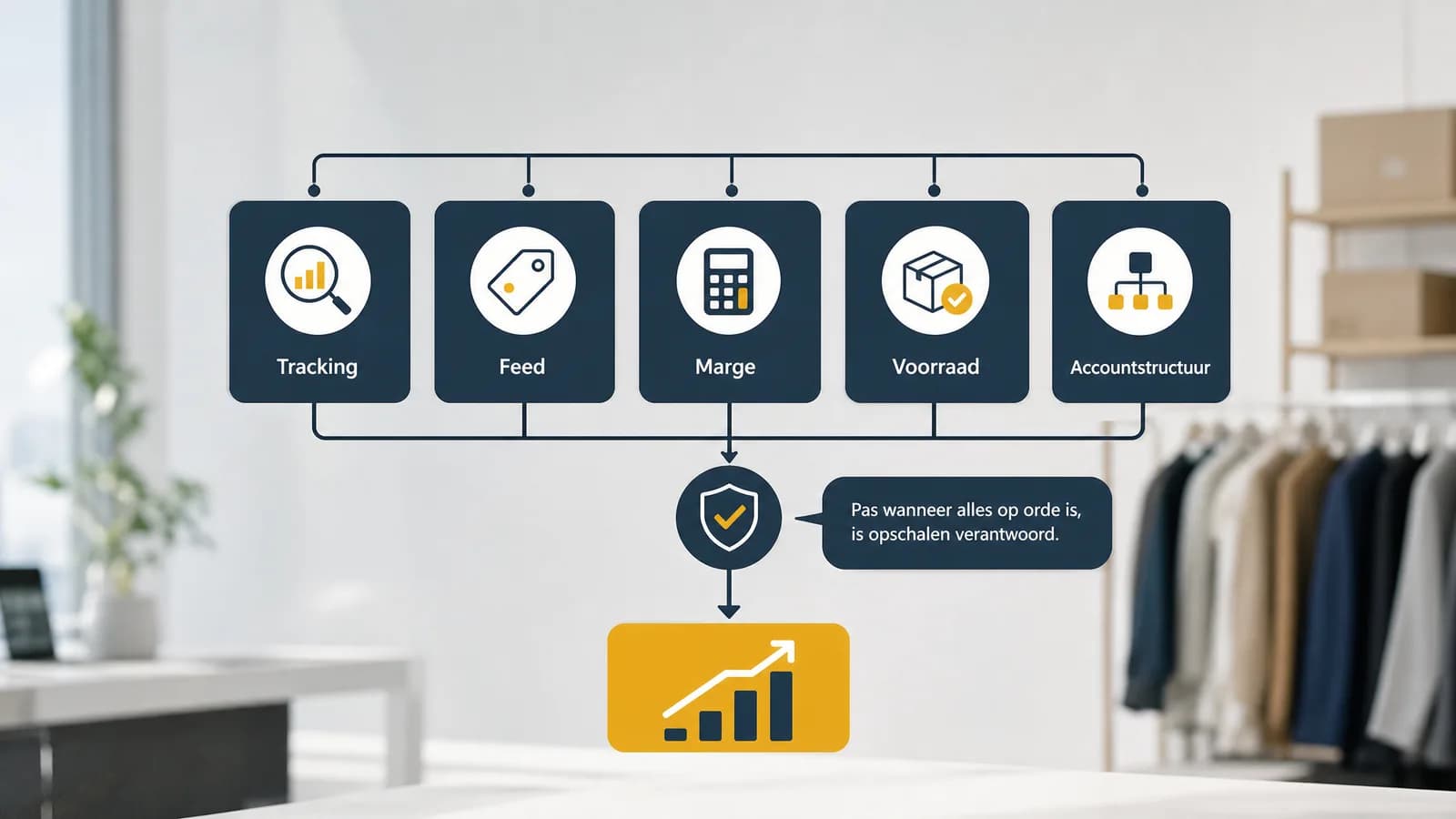
The scale-readiness check for online stores
Before raising budget, you want to verify at least five areas: conversion tracking, product feed, margin, inventory, and account structure. Conversion tracking is the foundation. If revenue, conversion value, or transactions are not being passed through reliably, you are feeding bidding strategies on corrupted signals. That can mean Google Ads is optimising toward orders that are later cancelled, incorrectly valued conversions, or conversions being counted twice.
The product feed then determines how Shopping and Performance Max campaigns understand and show products. Titles, product types, availability, prices, and images must not only be technically correct but also commercially usable. A weak feed can still ride along on strong brand or product demand at low budget. At scale, feed quality becomes more important because you grow more dependent on broad auction moments and algorithmic matching.
Next comes margin. Do not work with just an average margin across the entire store. Segments often differ significantly. Accessories, bundles, seasonal products, bestsellers, and clearance items each have a different scaling headroom. When everything sits in one campaign or one objective, profitable and vulnerable products receive the same budget signal. That is rarely ideal.
Inventory and cash flow are equally important. Google Ads can accelerate demand, but it cannot fill your warehouse. If you scale hard on products with limited stock, you may be teaching the system to chase volume you cannot deliver consistently. At the same time, additional ad budget often requires pre-financing: costs arrive immediately, while margin only truly materialises after orders are processed and returns are settled.
Why automation is no excuse to skip diagnosis
Automation in Google Ads can take over a great deal of work, but it cannot determine what is healthy for your business. A bidding strategy does not automatically know which products are strategically important, which are return-sensitive, which customers will buy again, and which category only appears to have margin until shipping costs are included. The system can optimise on the signals you provide; it cannot replace your commercial strategy.
That is why automation works better when you supply clear objectives and usable segments. When conversion value is accurate, product groups are divided logically, and your target return aligns with real margin, the system has a better chance of learning in the right direction. When everything is mixed together, extra budget can actually create more confusion: the algorithm will find volume, but not necessarily the volume that makes your business stronger.
The difference usually lies in preparation. An online store that knows which categories may grow, which products have limited scalability, and where measurement data is reliable can deploy automation in a more controlled way. An online store that only sees that the campaign performed well last month is taking a bigger gamble the moment budget goes up.
When do you give campaigns more room?
Increasing budget makes sense when a campaign or segment shows multiple positive signals simultaneously. Think of stable conversion value, sufficient conversion volume, healthy margin, available inventory, and a search or product segment that is not yet clearly saturated. One good week is usually too little evidence. Look instead at patterns across multiple periods, including days with promotions, stock fluctuations, and seasonal influences.
Also raise budget incrementally. Large jumps can disrupt the learning process and make it harder to identify the cause of performance changes. If results decline after an increase, you want to know whether that stems from more expensive auctions, weaker search terms, a different product mix, tracking issues, or simply insufficient market demand. Smaller steps make diagnosis easier.
Sometimes raising budget is not the right next step. If a campaign is carried mainly by a handful of products, segmentation may be wiser. If feed titles are weak, improve the feed first. If conversion value is inaccurate, fix tracking. If returns are eating into margin, the target return needs to be adjusted. Scaling is therefore not a single button, but a series of decisions.

Product segmentation: winners, question marks, and loss-makers
A practical way to work scalably is to divide products into three groups: winners, question marks, and loss-makers. Winners have healthy margin, sufficient stock, clear demand, and reliable performance. They deserve controlled budget headroom. Question marks have potential but still lack proof. There you test feed improvements, pricing propositions, bundles, or landing pages. Loss-makers have structurally insufficient margin or too weak demand and should not automatically benefit from extra budget.
This classification prevents an average campaign result from misleading you. A campaign can look acceptable at the total level while a small portion of products generates the profit and the rest consumes budget. At scale that imbalance grows larger. By steering product groups more precisely, you give Google Ads better boundaries and prevent budget from flowing toward the wrong inventory.
That said, segmentation must not tip over into fragmentation. Too many small campaigns with too little data can actually weaken automation. The art is creating commercially relevant segments that are large enough to learn from and specific enough to steer on margin and objective.
The Funnel Adviseur take-away
Treat the new phase of Google Ads as a reason for an audit, not as an excuse to spend more money without control. The question is not whether you should use automation, but whether your business is supplying the right signals and can process additional demand profitably. That is a difference in mindset: from campaign management to scale management.
For online stores that want to grow, the best first step is often not a new campaign but a scale-readiness session. Verify tracking, feed, margin, inventory, returns, product mix, and cash flow. Only then decide where budget may increase, where segmentation is needed, and where pausing is smarter than continuing to optimise. Google Ads can be a powerful growth engine, but only if you stop pushing harder on a system that is not yet solid enough to take the load.