
Scaling Google Ads? Fix Your Feed and Fulfilment First

The Wrong Scaling Question: How Much Budget Can We Add?
Many e-commerce accounts ask the scaling question too late and too narrowly. The question becomes: how much extra budget can we put into Google Ads without the ROAS immediately collapsing? That sounds logical, but it is usually not the best starting point. A better question is: which bottleneck gets bigger the moment we increase the budget?
Google Ads amplifies what is already there. A strong product feed gets more opportunities. A messy feed gets more messy impressions. A sharp offer gets more sales moments. A mediocre landing page mostly gets more expensive hesitation. And if operations cannot handle the extra demand, growth quickly turns into longer delivery times, more support pressure, and a worse customer experience.
That is why scaling is not a standalone advertising lever. It is a chain decision. Campaigns, feed, margin, inventory, fulfilment, and reporting all need to be able to support what extra budget unlocks. Skipping that step may show more revenue in the short term, but rarely builds a more reliable growth system.
Diagnose Your Product Feed First
For Shopping and Performance Max, the product feed is not an administrative detail. It is one of the most important information layers through which products are understood, matched to search intent, and presented to potential buyers. If titles are too generic, categories are sloppy, variants are unclear, or availability is incorrect, you are feeding your campaigns with flawed input.
Start with the feed, not with bids. Check whether your most important products have clear titles with relevant attributes such as brand, type, material, size, colour, or application. See whether product types are logically grouped. Verify that images are professional enough and that price information, stock status, and shipping details match what the customer sees on the site.
Especially for online stores with large catalogues, a false sense of scalability can easily arise. Hundreds or thousands of items are ready, so the budget can go up. But if only a small portion of the range is commercially strong, well described, and margin-worthy, you do not want the algorithm freely distributing budget across everything that happens to attract clicks.
ROAS Is Not a Blank Cheque to Scale Blindly
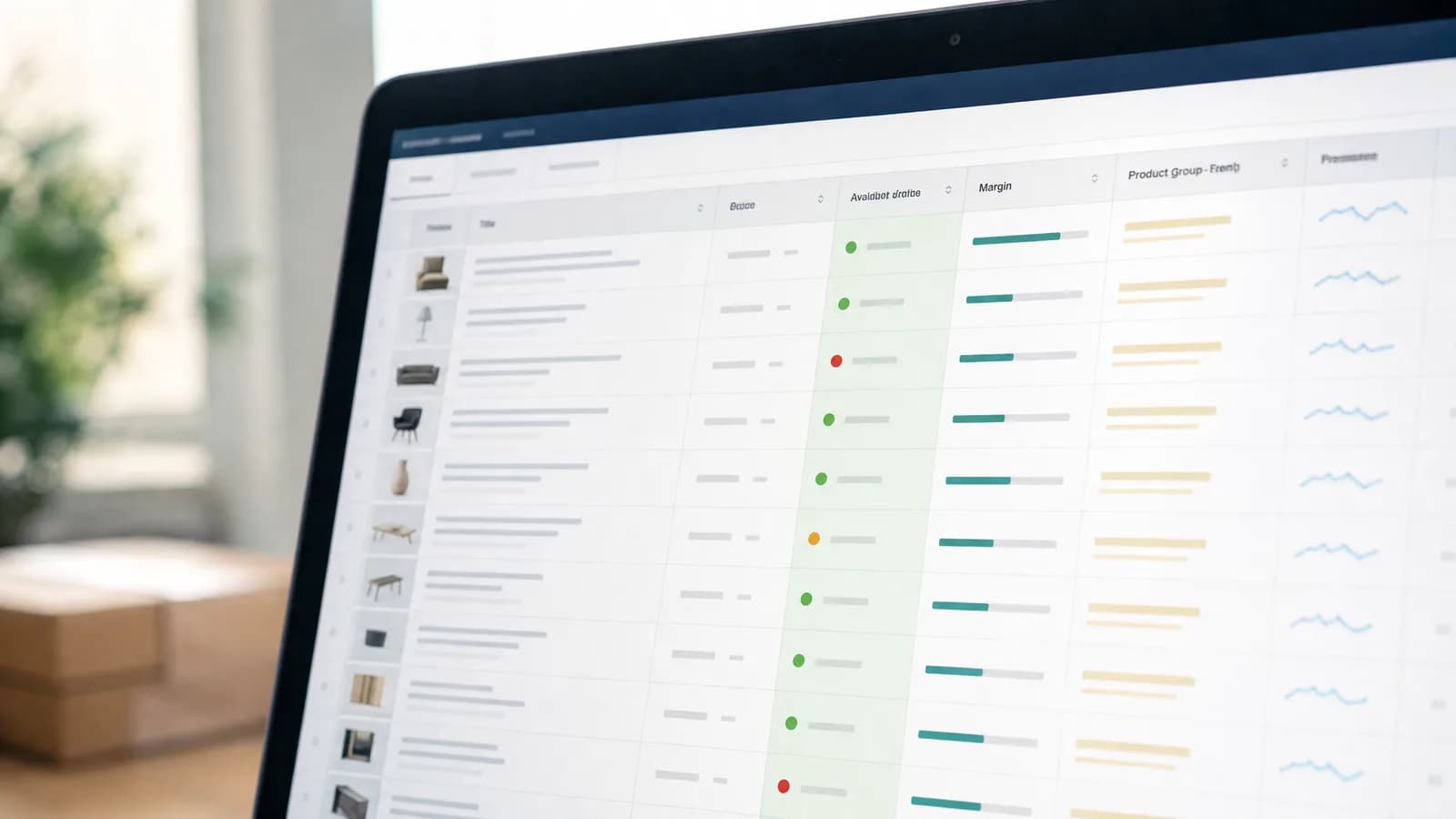
A healthy ROAS at account level can mask the fact that some product groups are carrying the growth while others are simply along for the ride. When you increase budget, the mix often changes. You do not automatically buy more of the same profitable demand; you also reach broader, colder, or less purchase-ready segments. As a result, a figure that looked fine at lower volume may prove less robust under scaling pressure.
Before scaling, therefore, look at margin per product group, return risk, inventory position, and average order value. A product with high revenue but low margin may have less room to scale than a smaller product with a more stable profit contribution. Inventory is also critical: a campaign that grows hard on products that are nearly out of stock does not create sustainable growth but operational disruption.
Make it concrete with segments. Which products can receive more budget? Which products should be kept in check? Which categories primarily bring in new customers, and which are only interesting for repeat purchases or bundles? Without those choices, ROAS targeting becomes too blunt and you end up reacting to problems you could have anticipated.
Performance Max or Search: Choose Based on Maturity
The choice between Search, Shopping, and Performance Max is too often framed as a campaign-type debate, as if one format is automatically the right scaling route. In reality, the choice depends on your need for control, data quality, feed quality, conversion volume, and commercial clarity.
Search gives relatively more control over search terms, ad copy, and intent. That can be valuable when you still want to understand exactly which queries convert. Shopping and Performance Max can be more interesting when the feed is strong, conversion tracking is reliable, and you have enough signals to optimise at the product level. But if your feed is weak or margins vary significantly, broad automation can also push budget towards the wrong places faster.
For dropshipping-style or rapidly changing catalogues, that trade-off is especially important. Product range, pricing pressure, delivery times, and competition can shift quickly. In that case, you want to know not only which campaign is theoretically scalable, but also how much control you need to rein in losers in time and deliberately give winners room to grow.
Fulfilment Is Also a Google Ads Problem
Marketers sometimes treat fulfilment as if it falls outside the advertising domain. The campaign delivers orders; after that it is up to operations. In practice, that separation is artificial. If delivery times increase, customer service falls behind, or inventory updates become unreliable, it affects the commercial performance of future campaigns.
Sometimes pulling back budget is not a sign of failing marketing but of smart steering. You prevent creating extra demand that the business cannot handle well. Especially in e-commerce, customer satisfaction is part of the growth engine. Poor delivery can lead to more returns, lower repeat purchases, worse reviews, and more friction for new buyers.
Include fulfilment in your scaling conversations. How many additional orders can the team handle? Which products are sensitive to delivery issues? Which suppliers are stable enough for higher volume? And when should marketing temporarily ease off to protect the customer promise?

A Practical Scaling Checklist
Use a short checklist before increasing budget. One: are the most important products complete, distinctive, and up to date in the feed? Two: do you know which product groups have sufficient margin to support growth? Three: is it clear which campaigns or asset groups contain winners and losers? Four: can inventory and fulfilment reliably handle extra volume? Five: are you measuring not only revenue and ROAS, but also profit contribution, return risk, and operational pressure?
If any of these questions is still unclear, that does not have to block scaling entirely. It does mean you should test in a controlled way rather than increasing aggressively. Work with product groups, clear budget steps, and short evaluation moments. That way you learn where the real growth ceiling lies.
The role of a good Google Ads specialist is therefore broader than managing settings. You connect advertising data with commercial reality. Not every online store immediately needs more budget; often the account first needs more clarity in feed, offer, measurement plan, and operations.