
Parents co-signing: discuss the support request first
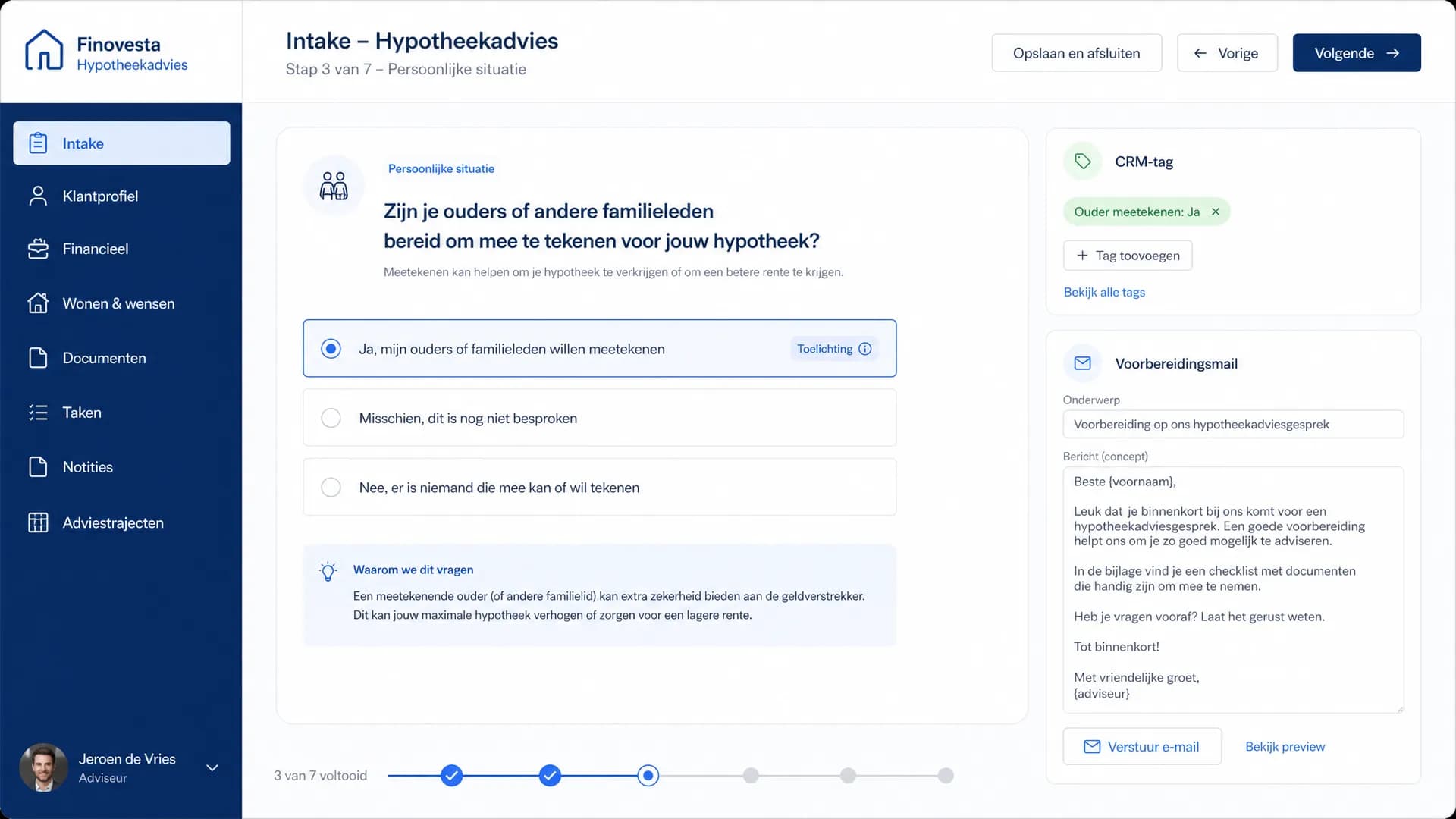
The choice: turn ‘co-signing’ into an intake signal
Before the appointment, include one open question: ‘Do you expect financial support from parents or other family members, and what form of support do you have in mind?’ Record the answer as a discussion signal, not as an outcome or an expectation of approval. This is necessary because parental support can take different forms. Vereniging Eigen Huis lists a gift, a loan from parents and joint liability as ways in which parents can play a role in financing a first home. The supplied passage describes these options, but not the conditions or applicability for an individual client. A useful tool is a decision log in the CRM. For each case, record: the expected form of support, who is offering it, what the client thinks it will solve, what the adviser needs to verify and what explanation has been sent in the confirmation email. This shifts the question from ‘is it possible?’ to an agenda for the appointment.
Let the confirmation email set boundaries for expectations
When a family-related signal is reported, send a brief, neutral preparation: discuss during the appointment what form of support is intended, which parties play a role and which conditions still need to be investigated. Avoid promising additional borrowing capacity. Vereniging Eigen Huis’s passage on a guarantee states that the lender may require the child to be able to carry the loan independently over time and assesses whether the guarantor can financially bear the liability. The same passage also says that acting as guarantor may limit the guarantor’s own borrowing capacity. These are relevant discussion points; the passage does not provide a general decision rule for every lender or client. For example, use the following in the email: ‘We will include your question about support from your parents. During the appointment, we will assess not only the proposed arrangement, but also its consequences and the information needed for it.’ This allows automation to prepare the advice without simulating it.
Record the boundary between preparation and advice in the case file
The income assessment is a reason not to treat a family-related signal as a quick solution. The supplied AFM passage explains that the loan-to-income assessment indicates how much someone may borrow relative to their income and that an adviser uses debt-service ratios set out in law. The passage concerns the income assessment; it does not support the claim that parental support changes the outcome in all situations. Therefore, use this standard checkpoint before the appointment: record the form of support, the owner of the verification, the required documentation and the follow-up decision for this mortgage application. This log makes visible what has already been collected and what still requires advice or assessment. This article provides general process information for mortgage advisers and is not an assessment of an individual client’s legal position, creditworthiness, tax consequences or likelihood of approval.